IDEAS supports the possible reintroduction of GST and calls for a comprehensive study to gauge its impact on vulnerable households
Kuala Lumpur, 11 June 2022 – The Institute for Democracy and Economic Affairs (IDEAS) supports the possible reintroduction of the Goods and Services Tax (GST) in Malaysia, but a comprehensive study and various rounds of consultation to examine the impacts on vulnerable households and groups are necessary prior to its possible implementation. Other policy measures such as targeted subsidies and a formalised social safety net programme also need to be in place to cushion the potential price hikes post GST in the immediate term.
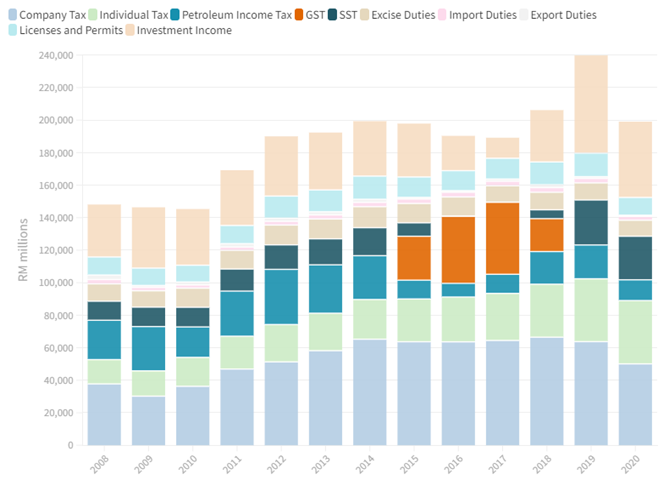
In general, GST is needed to sustainably broaden government revenue streams in the face of the widening budget deficit. There is room to broaden the domestic tax base to strengthen Malaysia’s fiscal sustainability. From the GST collection it is proven to be able to drive a higher revenue than the current SST collection, and has evidently ameliorated Malaysia’s dependency on petroleum income tax to a certain extent, which is subject to the volatility of the global oil market.
Looking at the data from 2011 to 2020, around 55% of the government’s revenue came from direct taxes on average. Among that, the share of petroleum income tax was on a declining trend especially since the global oil price plunge in 2015. This decline had been offset to a certain degree by the implementation of GST from 2015 to 2017. When GST was introduced in 2015, it constituted about 14% of the government’s revenue, and this share steadily increased to 23.41% in 2017. Overall SST contribution only made up 8%-14% of the government’s revenue.
IDEAS CEO, Tricia Yeoh, points out, “GST is more comprehensive and it captures more accurately the economic activities and functions within an economy. In the long run, GST will create a sustainable and stable fiscal revenue source for the government that they can then use for investing into the future, on healthcare and education, among other priority sectors”.
Nevertheless, a comprehensive study and a thorough consultation process are needed to determine what the right rate should be in a given economic setting. A GST rate that is too high may dampen demand and/or cause additional inflationary pressures in an already uncertain environment. A rate that is too low may not make a dent in expanding the government’s revenue base. Additionally, awareness and training programs and execution planning are needed to ensure that confusion over refund, exemption and calculation issues can be eliminated, learning from past mistakes.
IDEAS Director of Economics and Business Unit Juita Mohamad, emphasises that, “With a broader revenue base, the government should consider creating a formalised social safety net that targets vulnerable households, pensioners and even displaced workers in the informal sector in a consistent manner. Even though in the immediate term, one-off cash transfer programs can cushion the blow stemming from price hikes and lockdowns, in the long term it is not the best measure to assist vulnerable households in a sustainable way. With redistribution of wealth through the collection of GST, if done correctly, it can be a powerful tool for poverty alleviation.”
IDEAS believes that the possible reintroduction of the GST needs to be done in a timely and well-planned manner, especially when the local and global economies are still quite fragile. When the GST is introduced in the future with other policies such as a formalised social safety net as well as rationalisation of subsidies by putting emphasis on targeted subsidies, the short term costs of its possible reintroduction can be minimised.
— END —
Download Media Statement PDF File Here
For enquiries, please contact:
Dr Juita Mohamad, Director, Economic and Business Unit
Acting Director of Research
T: +603 2070 8881/8882 | E: juita@ideas.org.my
Louis Denis, Manager, External Relations
T: +603 2070 8881/8882 | E: louis@ideas.org.my

